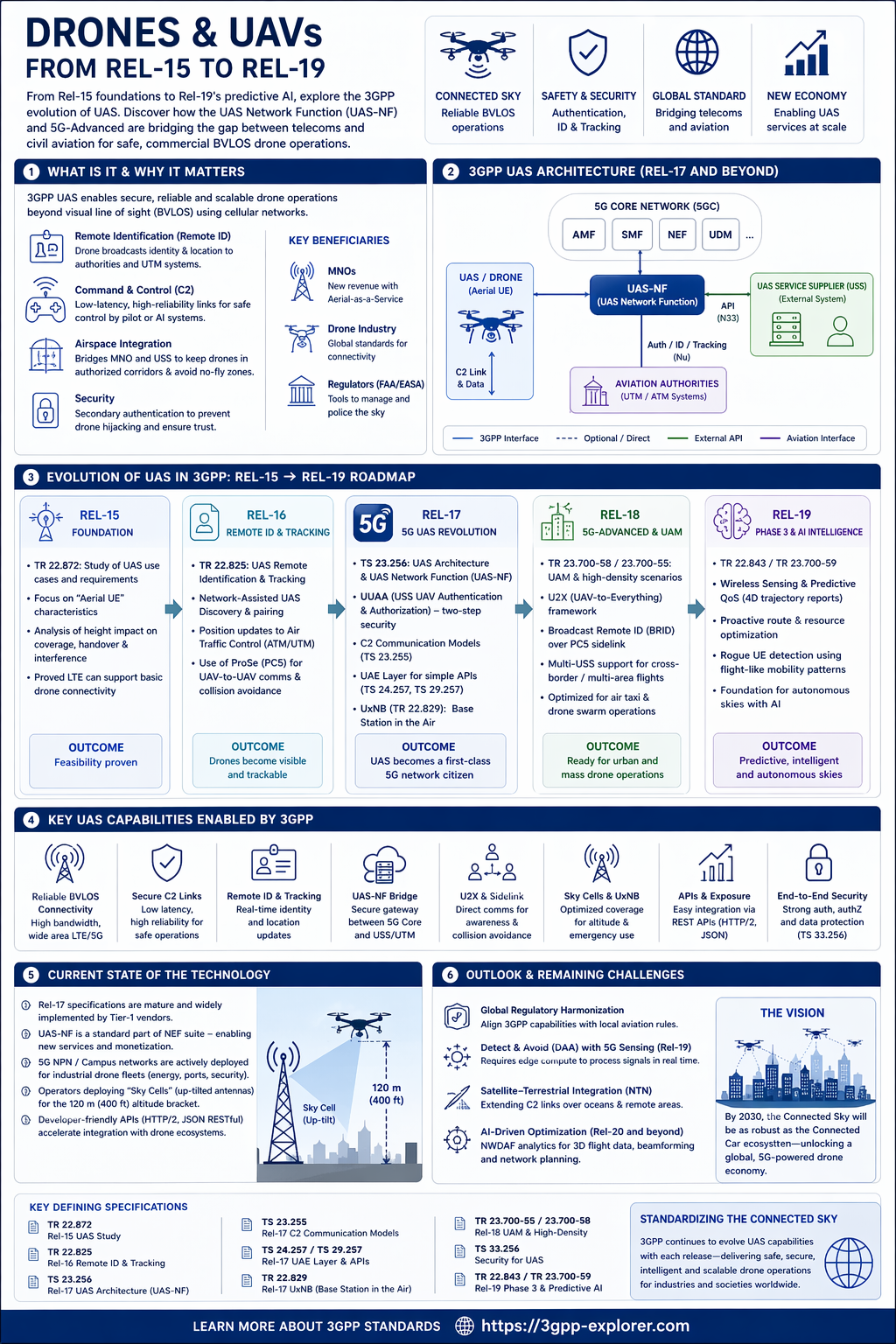
The Sky is the Limit: The Architectural Evolution of 3GPP Uncrewed Aerial Systems
In the rapidly evolving landscape of telecommunications, the integration of Uncrewed Aerial Systems (UAS)—commonly known as drones—into the cellular fabric represents one of the most significant shifts in 3GPP’s history. Traditionally, mobile networks were optimized for ground-based users, with antennas tilted downward to maximize terrestrial coverage. However, the surge in commercial drone applications, from automated logistics and 8K infrastructure inspections to emergency response and Urban Air Mobility (UAM), necessitated a fundamental redesign of the 3GPP core and access networks. The standardization journey from Release 15 to the upcoming Release 19 reflects a transition from drones being 'accidental' aerial users to becoming 'first-class' network citizens with specialized protocols, security frameworks, and dedicated network functions.
What is it and why it matters
The primary motivation for 3GPP standardization of UAS is the enablement of Beyond Visual Line of Sight (BVLOS) operations. Until recently, most drone flights were limited by the operator’s physical line of sight. To scale drone technology for industrial use, such as long-distance medical delivery or autonomous power-line monitoring, a reliable, high-bandwidth, and wide-area communication link is required. Cellular networks (LTE and 5G) are the only infrastructure capable of providing this at scale.
However, flying drones present unique challenges. They operate in 3D space, meaning they can cause and receive interference differently than ground UEs (User Equipment). They also require stringent safety protocols to satisfy Civil Aviation Authorities (CAA). 3GPP’s UAS specifications solve several critical real-world problems:
- Remote Identification (Remote ID): Standardizing how a drone broadcasts its identity and location to law enforcement and air traffic management (UTM) systems.
- Command and Control (C2): Providing low-latency, high-reliability links to ensure the pilot or an AI system can maneuver the aircraft safely.
- Airspace Integration: Bridging the gap between the Mobile Network Operator (MNO) and the UAS Service Supplier (USS) to ensure drones stay within authorized corridors and avoid no-fly zones.
- Security: Preventing 'drone hijacking' through secondary authentication layers that verify the aircraft’s identity against aviation databases.
The beneficiaries of this technology span the entire ecosystem. MNOs gain a new revenue stream by offering 'Aerial-as-a-Service'; drone manufacturers like DJI or Skydio get a global standard for connectivity; and regulators like the FAA or EASA gain the tools needed to police a crowded sky.
History of Development: From Rel-15 to Rel-19
The evolution of UAS in 3GPP has been a methodical process of identifying radio challenges, building an architectural bridge to aviation systems, and finally optimizing for complex urban environments.
Release 15: The Foundation
The journey began with TR 22.872, which analyzed the initial use cases and performance targets for 3GPP-connected drones. At this stage, the focus was primarily on 'Aerial UE' characteristics—understanding how the height of a drone affects handover performance and interference with neighboring cells. This era was about data gathering, proving that LTE could support basic drone connectivity with minimal modifications to the existing radio software.
Release 16: Remote ID and Tracking
Release 16 marked the first major architectural step with TR 22.825. It introduced the concept of 'UAS Remote Identification and Tracking.' The industry realized that for drones to be legal, they must be trackable. This release established the requirements for the network to provide positional updates to Air Traffic Control. It introduced the innovation of 'Network-Assisted UAS Discovery,' allowing controllers and drones to pair via the cellular fabric rather than just proprietary radio links. It also touched on the use of ProSe (Proximity Services) for direct UAV-to-UAV communication for collision avoidance in areas with patchy network coverage.
Release 17: The 5G UAS Revolution
Release 17 is arguably the most critical milestone, as it moved from studies to normative specifications (Stage 3). TS 23.256 established the architectural framework for 5G UAS, introducing the UAS Network Function (UAS NF). This function acts as the vital gateway between the 5G Core (5GC) and the external UAS Service Supplier (USS).
Key innovations in Rel-17 included:
- UUAA (USS UAV Authentication & Authorization): A two-step security process where the drone first authenticates with the 3GPP network, and then performs a secondary authentication with the aviation authority via the UAS NF.
- C2 Communication Models: Defined in TS 23.255, these models allowed for dynamic switching between direct controller-to-drone links and network-assisted links.
- The UAE Layer: The UAS Application Enabler (UAE) layer (defined in TS 24.257 and TS 29.257) was introduced to abstract the 3GPP complexities into simple APIs for drone software developers.
- UxNB: TR 22.829 explored the 'Base Station in the Air' concept, where a drone carries a small cell to provide emergency coverage on the ground.
Release 18: 5G-Advanced and Urban Air Mobility
With Release 18 (5G-Advanced), the focus shifted to Urban Air Mobility (UAM) and more complex flight scenarios. TR 23.700-58 and TR 23.700-55 addressed the needs of 'air taxis' and high-density drone swarms. A major addition was the U2X (UAV-to-Everything) framework, adapting V2X (Vehicle-to-Everything) technology for the sky. This release introduced Broadcast Remote ID (BRID) over the PC5 sidelink interface, ensuring drones can 'announce' their presence to anyone nearby, even without a network connection. It also introduced multi-USS support, allowing a drone to fly across borders or different service areas without losing its tracking session.
Release 19: Phase 3 and Predictive Intelligence
The current frontier, Release 19 (Phase 3), as seen in TR 22.843 and TR 23.700-59, focuses on Wireless Sensing and Predictive QoS. Instead of just reacting to a dropped connection, the network can now provide a '4D trajectory' report to the drone, predicting signal strength along its flight path. If a 'dead zone' is predicted 2km ahead, the drone can proactively adjust its route. This release also introduces 'Rogue' UE detection, using flight-like mobility patterns to identify and ground unauthorized drones that are using standard SIM cards to bypass aerial restrictions.
Current State of the Technology
Today, UAS technology in 3GPP has reached a high level of technical maturity. The Release 17 specifications are being actively implemented by Tier-1 vendors (Ericsson, Nokia, Huawei) and integrated into 5G Core products. The UAS-NF is now a standard component of the Network Exposure Function (NEF) suite, allowing operators to monetize their data by selling tracking and authorization services to aviation agencies.
Deployment readiness is high for industrial 'Campus' networks. Large energy companies and ports are already deploying 5G NPNs (Non-Public Networks) to manage autonomous drone fleets for site security. However, on public networks, the challenge remains the 'down-tilt' of antennas. To solve this, operators are beginning to deploy 'Sky Cells'—antenna arrays specifically tilted upward to serve the 120-meter (400ft) altitude bracket where commercial drones operate. Protocol-wise, the use of HTTP/2 and JSON-based RESTful APIs (as specified in TS 29.256) has made it significantly easier for the Silicon Valley-centric drone industry to integrate with the traditionally conservative telecom world.
Outlook and Remaining Challenges
While the roadmap from Rel-15 to Rel-19 has been comprehensive, several hurdles remain. The most significant is Global Regulatory Harmonization. While 3GPP provides the 'how,' the 'when' and 'where' are still dictated by local aviation authorities. The integration of Detect and Avoid (DAA) using 5G sensing (Rel-19) will be a game-changer, but it requires massive computational power at the Edge to process radar-like signals in real-time.
In upcoming studies, we expect to see more focus on Satellite-Terrestrial integration. For drones flying over oceans or remote deserts, the 5G Non-Terrestrial Network (NTN) will be the only way to maintain the C2 link. Furthermore, AI-driven flight path optimization will likely become a core part of Release 20, as the NWDAF (Network Data Analytics Function) begins to ingest 3D flight data to optimize beamforming for aerial targets.
The market expectation is that by 2030, the 'Connected Sky' will be as robust as the 'Connected Car' ecosystem is today. With the security foundations laid in TS 33.256 and the application layers standardized in TS 24.257, the industry finally has the blueprint to move from experimental pilot programs to a global, 5G-powered drone economy.